
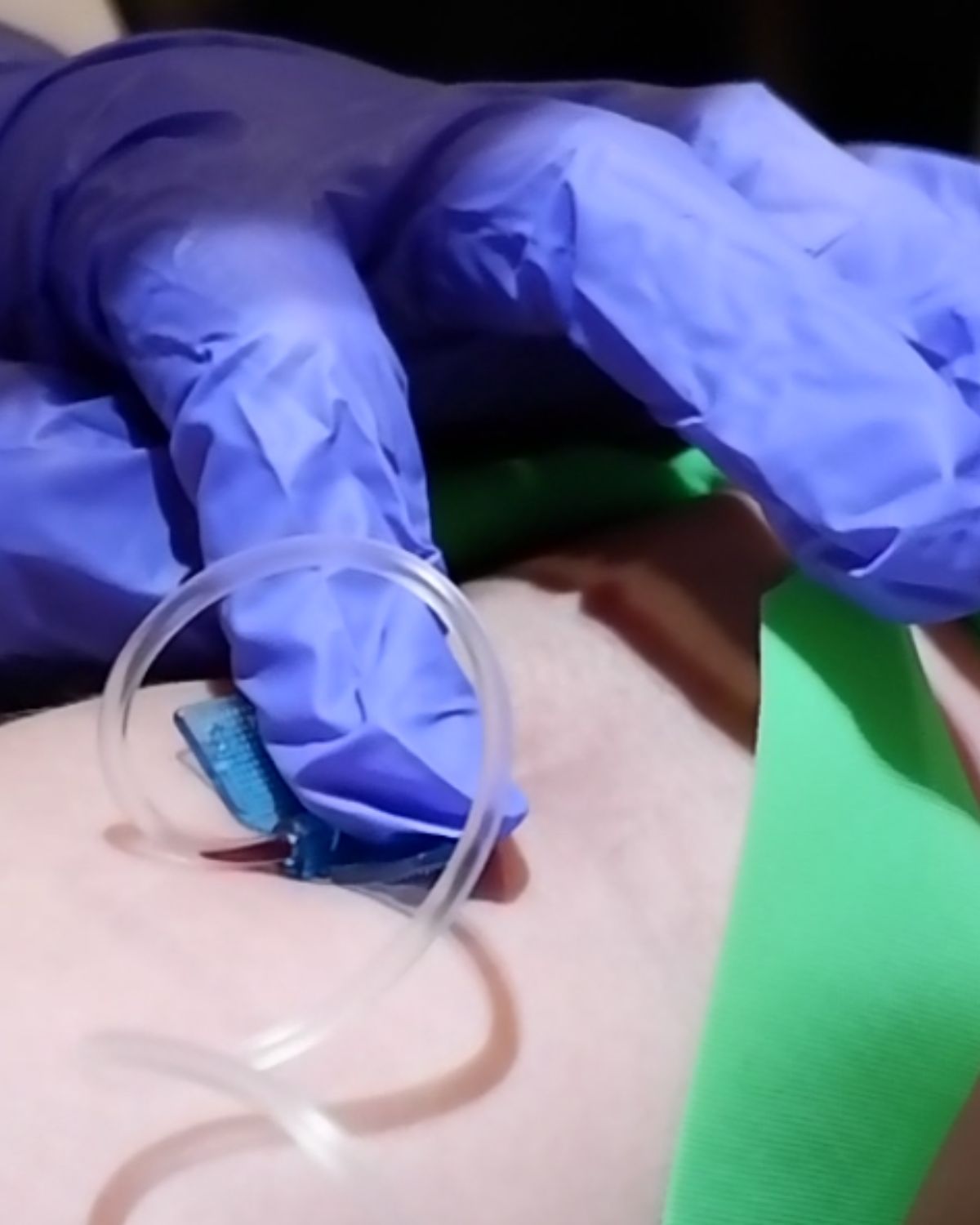
Every week in clinic, a patient pulls out her phone and shows me a screenshot of an IV drip ad. She asks if the whitening promises are real. The honest answer is some of them, sometimes, for specific patients. The rest is marketing.
Here is what IV drip therapy in BGC actually is, what glutathione and vitamin C actually do at the cellular level, who it is for, and how we do it safely at VMA.
What IV drip therapy in BGC actually is
IV drip therapy is the delivery of high-dose nutrients (vitamins, antioxidants, amino acids, minerals) directly into the bloodstream through a small catheter in a vein. It bypasses the gut entirely. That is the whole point.
The gut is a filter. When you swallow vitamin C, your small intestine has saturable transporters that can only absorb a fixed amount per dose, around 200 milligrams at a time. Take 1,000 milligrams orally and you absorb maybe 250 of it. The rest is excreted. Take 5,000 milligrams orally and you do not absorb 5,000; you absorb the same 250 and the rest passes through.
IV delivery removes the cap. The same 5,000 milligrams given intravenously achieves blood levels 20 to 30 times higher than oral dosing can ever reach. That difference is not theoretical. It is pharmacokinetics.
This is also why oral glutathione is a poor product. The molecule is digested in the gut into its three amino acid building blocks (glycine, cysteine, glutamate). What reaches your skin is not the original antioxidant; it is the raw material, which your liver may or may not reassemble. IV delivery gives you the intact molecule.
What glutathione actually does
Glutathione is the body’s master antioxidant. Every cell makes it. Every cell needs it. It scavenges free radicals (the unstable molecules that damage DNA, proteins, and cell membranes), regenerates other antioxidants like vitamin C and vitamin E, and supports the liver’s detoxification pathways.
When you are young, your cells make plenty. By your forties, levels drop. Chronic stress, alcohol, pollution, UV exposure, and poor sleep accelerate the decline. The result is what dermatologists see in clinic: duller skin, slower wound healing, more visible pigment, and skin that does not bounce back from a late night the way it used to.
Glutathione works on the skin through a specific mechanism. It inhibits an enzyme called tyrosinase (the enzyme that produces melanin) and shifts melanin production from the darker eumelanin toward the lighter pheomelanin. The result, when it comes, is a more even tone and a brighter complexion. It is not bleaching. It is rebalancing.
Two honest notes. The brightening effect is modest. It is consistent in patients with high oxidative stress and disappointing in patients whose skin tone is what their genetics intended. Glutathione will not turn a Fitzpatrick V into a Fitzpatrick II, and no responsible physician would promise that.
What vitamin C actually does
Vitamin C is a cofactor for collagen synthesis. Without it, your fibroblasts (the cells that make collagen) cannot complete the cross-linking step that makes collagen strong. This is why scurvy patients fall apart at the seams; their old collagen wears out and the new collagen never finishes assembling.
In aesthetic doses, IV vitamin C does three useful things. It saturates the antioxidant pool. It supports the collagen-building machinery. And at high doses, it has shown in some studies a mild pro-oxidant effect inside tumor cells, which is why integrative oncologists have used it as a supportive therapy. That last use is outside our cosmetic indication, but it tells you something about the molecule: it is not a vitamin in the conventional weak-supplement sense at IV doses. It is a real drug at a real concentration.
For skin, IV vitamin C pairs well with glutathione. The two regenerate each other. One alone gives you part of the benefit. Together they close the loop.

Who IV drip therapy in BGC is for
Patients with high oxidative stress: long hours, frequent travel, chronic sleep debt, heavy work or training schedules, recovering from illness. Patients with dull skin that is not responding to topicals. Patients who want to support a course of regenerative work by giving the skin its biochemical inputs from the inside while we treat it from the outside.
It is not for patients who want a guaranteed lighter complexion. It is not for patients who are pregnant or breastfeeding. It is not for patients with active asthma, G6PD deficiency, or significant kidney disease without clearance from their primary physician. It is not for patients who would rather buy a drip than sleep eight hours and eat real food. The drip is leverage on a foundation. It is not a substitute for the foundation.
How a session at VMA runs
Every IV drip session at VMA is administered by a physician or by a trained nurse under physician supervision. We confirm your health history, take baseline vitals, place a small IV catheter, and infuse the formulation slowly over 45 to 90 minutes depending on dose and tolerance.
The infusion itself feels like sitting through a slow drink. Some patients feel a mild cool sensation along the arm at the start. Some feel slightly more alert by the end. Most patients feel nothing during the session and notice a subtle change in skin glow over the next few days.
A typical course is six to ten sessions, weekly or twice weekly, with maintenance once or twice a month afterward. The plan should be written, not freelanced. We review it at the consult.
How IV drip therapy fits with the rest of our protocols
IV drip therapy is a biochemical support tool. It does not replace topical, laser, or injectable treatments. It works alongside them. The drip supplies the building blocks; the surface treatments do the structural work.
For texture and pigment, we use Hollywood Spectra and chemical peel options. For dermal regeneration, we use PDRN and exosome facials. For deeper structural lifting, we use Ultherapy in BGC. For motion lines, we use Botox or Xeomin. A well-planned month may pair an IV course with one of these, so the skin gets both its raw materials and the right stimulus.
The honest part
Three things every patient considering IV drip therapy in BGC needs to hear.
One. The market is full of unsupervised setups. Salons, home infusions, drive-through drip bars. Some are reputable. Many are not. An IV is a real medical intervention. The risk of contaminated solution, wrong electrolyte balance, or anaphylaxis from a sloppy formulation is small but real. Confirm the prescriber. Confirm the compounding pharmacy. Ask. A real clinic will not be offended.
Two. The brightening claims are oversold. Glutathione will not turn anyone three shades lighter. The honest result is a healthier, more even, more luminous version of your own skin. If a clinic is selling you a “whitening drip” with a guaranteed result, the marketing has run ahead of the biochemistry.
Three. IV drips do not outrun your fundamentals. Sleep, protein intake, sun protection, and stress regulation matter more than any vitamin you can pay to receive. The drip works best in the patient who is already doing the boring things well. If your inputs are poor, no infusion will give you durable results.
If you would like to know whether IV drip therapy in BGC is the right fit for your skin and your physiology, you can book a consultation or read more about our team on the About page. The full menu of services is at velascomedical.com.
For the underlying science, you can browse the peer-reviewed literature on PubMed’s indexed studies on intravenous glutathione and skin pigmentation.
This article is educational and is not medical advice. Please consult a qualified physician before starting any aesthetic or infusion therapy.
Frequently Asked Questions
Is IV drip therapy in BGC safe?
Yes, when performed by a physician or by a trained nurse under physician supervision, with sterile technique, pharmaceutical-grade compounding, and a documented health history. The risks of unsupervised IV infusion are vein irritation, electrolyte imbalance, allergic reaction, and infection. Those risks fall close to zero in a properly run clinic.
How many sessions of IV drip therapy in BGC do I need to see results?
Most patients see a subtle glow change after the first or second session. The more durable shift in tone and brightness appears at four to six weeks, after a course of six to ten sessions. Maintenance is once or twice a month afterward. The protocol depends on the patient.
Does IV glutathione actually whiten the skin?
It evens and brightens. It does not bleach. Glutathione inhibits tyrosinase and shifts melanin production toward the lighter type, which makes a meaningful difference in patients with hyperpigmentation or oxidative dullness. It will not change your underlying skin tone by multiple shades. Any clinic promising that is selling the wrong story.
Can I combine IV drip therapy in BGC with PDRN, Ultherapy, Hollywood Spectra, or Botox?
Yes, with thoughtful sequencing. IV drips can usually be given on the same day as injectable or laser work, as long as the schedule is planned by a physician. Random stacking is how patients waste money.
Is oral glutathione or vitamin C as effective as the IV version?
For everyday wellness, oral supplementation maintains baseline antioxidant function and is sufficient for healthy patients. For aesthetic or therapeutic intent, no. Oral glutathione is degraded in the gut and never reaches the skin in usable form. Oral vitamin C is capped by intestinal transporter saturation at around 200 milligrams per dose. The IV route reaches concentrations the gut cannot deliver.
Who should not get IV drip therapy?
Patients who are pregnant or breastfeeding, patients with active asthma, patients with G6PD deficiency, patients with significant kidney or heart disease, and patients with severe needle phobia. A physician should screen for these before booking, not after.
The shortcut is the long road. The body builds glow the same way it always has, from the inside out. The drip is the lever. The decision to start is yours.
Leave a Reply